Order Free Sample


Loose skin is one of the most searched and least honestly answered questions in weight loss.
The internet is full of creams, wraps, and supplements promising to tighten skin after significant loss, and very little of it holds up.
This guide covers what determines how much loose skin develops, what nutrition and training can genuinely influence, and where the honest answer is that surgery is the only thing that removes it.
Quick Summary
- How much loose skin develops depends mostly on factors you cannot change: age, genetics, how long the weight was carried, and how much was lost.
- Skin has elastic capacity, and past a certain point of stretching and duration, it does not fully retract.
- Nutrition and resistance training influence skin quality and how loose skin looks. Neither removes it.
- Protein, vitamin C, zinc, and collagen are the nutritional inputs most relevant to skin structure.
- Losing weight more gradually may help modestly, but it does not prevent loose skin after very large losses.
- Skin removal surgery is the only intervention that reliably removes excess skin, and it is worth understanding as an option rather than a failure.
Who This Guide Is For
This guide is designed for:
- Anyone who has lost significant weight and is noticing loose skin.
- Patients planning bariatric surgery or starting a GLP-1 medication who want realistic expectations.
- People trying to work out whether creams, wraps, or supplements are worth spending money on.
- Anyone weighing whether skin removal surgery is something to consider.
What Determines How Much Loose Skin You Get
Skin stretches to accommodate the body underneath it. Its ability to retract afterward depends on elastin and collagen in the dermis, and both are finite.
The factors that matter most are largely outside your control:
- Age. Collagen production declines steadily from the mid-twenties, so the same weight loss produces more loose skin at 50 than at 25.
- How much weight was lost. Losses of 100 pounds or more almost always leave some excess skin.
- How long the weight was carried. Years of sustained stretching damages elastic fibers in a way that does not fully reverse.
- Genetics. Skin quality and elasticity vary considerably between people for reasons no intervention changes.
- Sun exposure and smoking history, both of which degrade collagen independently of weight.
This list is worth reading carefully, because it explains why two people losing the same amount of weight can end up with very different results. It is not a difference in effort.
What Nutrition Can and Cannot Do
Being direct about this: no food, supplement, or nutrient removes loose skin. Anything claiming otherwise is overselling.
What nutrition does influence is skin quality, which affects how skin looks and feels and how well it retracts within whatever range your elasticity allows.
Protein
Skin is largely structural protein, and inadequate protein during rapid weight loss compromises the raw material for tissue maintenance and repair.
This is the most important nutritional input here, and it also happens to be the one most bariatric and GLP-1 patients fall short on.
Hitting a realistic daily target, whether you are several years past a sleeve or several months into a GLP-1 medication, matters more to skin outcomes than anything in this article that comes in a bottle.
Our BariSlim High Protein Shake in Chocolate delivers 15 grams of protein in a 9-ounce, low-sugar, low-carb serving, making it a straightforward way to hit your target on days when solid food falls short.
Vitamin C
Vitamin C is required for collagen synthesis. Without it, the body cannot build collagen properly regardless of how much protein is available.
Zinc
Zinc supports tissue repair and wound healing, both directly relevant to skin structure during active weight loss. Intake commonly drops after bariatric surgery or on a GLP-1 medication because zinc-dense foods, mainly meat, shellfish, and legumes, are eaten in much smaller amounts than before.
Hydration
Well-hydrated skin looks and behaves better than dehydrated skin, though the effect is real but modest. It does not change elasticity.
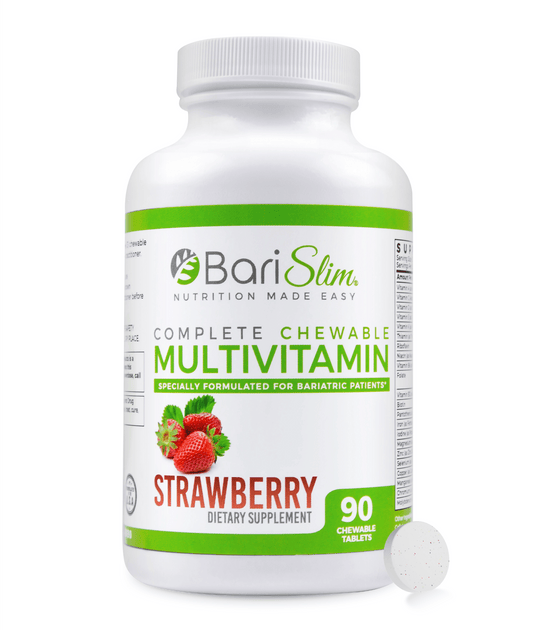
Our BariSlim Once Daily 45 Multivitamin Capsule packs vitamin C, zinc, and the broader micronutrient profile that supports tissue repair into a single 90-capsule bottle taken once daily. That matters most during exactly the period when food intake is reduced and these nutrients are hardest to get from meals alone.
Where Collagen Supplements Actually Sit
Collagen supplements are the most marketed product in this category, and the claims made for them are frequently overstated. It is worth separating what is plausible from what is not.
Ingested collagen is broken down into amino acids and peptides during digestion. It does not travel intact to the skin and rebuild it, which is how it is often described.
What research has looked at is whether specific collagen peptides act as signaling molecules that influence collagen production, and whether supplementation improves measures of skin elasticity and hydration.
Some studies report modest improvements in those measures, though the effects observed are real but small and concern skin quality rather than removal of excess skin.
The honest position: collagen is reasonable to include as part of a nutritional approach to skin quality during weight loss. It is not a treatment for loose skin, and anyone selling it as one is not being straight with you.
Our BariSlim Collagen Peptides is formulated as nutritional support for skin quality during active weight loss — not a treatment for loose skin, and not something that tightens or firms skin on its own.
Resistance Training: The Most Underrated Lever
Loose skin looks different depending on what is underneath it. Preserved or increased muscle mass fills space that fat previously occupied, which changes the appearance considerably even when the amount of skin is unchanged.
Resistance training also preserves lean mass during weight loss, which matters independently for metabolic rate and long-term maintenance.
Two to three sessions per week focused on major muscle groups is enough to make a meaningful difference, and sessions do not need to be long or advanced.
Compound movements such as squats, rows, presses, and hinges, performed consistently, produce results.
Of everything in this article, this is the intervention with the largest visible effect that does not involve an operating room.
When Surgery Is the Honest Answer
Body contouring surgery, which includes panniculectomy, abdominoplasty, brachioplasty, and thigh lift procedures, is the only intervention that removes excess skin.
Most surgeons recommend waiting until weight has been stable for at least six to twelve months, since further loss after the procedure produces new loose skin.
Insurance coverage varies: panniculectomy is sometimes covered when excess skin causes documented medical problems such as recurrent rashes or infections.
Procedures performed for appearance alone are generally not covered.
There is no failure in considering this. Loose skin after a 120-pound loss is a predictable physical consequence, not evidence of anything done wrong, and for many people addressing it is the last step of the process rather than an indulgence.
Frequently Asked Questions
Here are quick answers to the questions people ask most often about loose skin after major weight loss.
Can loose skin tighten on its own?
To a degree, and slowly: skin retracts over 12 to 24 months after weight stabilizes, and younger patients with smaller losses often see substantial improvement. After very large losses, some excess usually remains permanently.
Do creams, wraps, or massage tighten loose skin?
No, since these do not reach the dermal layer where elasticity is determined. Some improve skin surface appearance temporarily, but none reduce excess skin.
Does losing weight slowly prevent loose skin?
It may help modestly by giving skin more time to adapt, but it does not prevent loose skin after large losses. The total amount lost and how long the weight was carried matter more than the rate.
Is loose skin worse after bariatric surgery than after GLP-1 medications?
The driver is the amount and speed of weight loss rather than the method: bariatric surgery typically produces larger, faster losses, so loose skin is reported more often. Patients losing comparable amounts on a GLP-1 medication report it just as much.
Do collagen supplements help with loose skin?
Research suggests modest effects on measures of skin elasticity and hydration, which is a different thing from reducing excess skin, since no supplement does that. It is reasonable to include for skin quality, but it is not a treatment for the underlying issue.
When can I have skin removal surgery?
Most surgeons want weight stable for six to twelve months first. Talk to your bariatric team, who can usually refer to a plastic surgeon familiar with post-bariatric body contouring.
Support Your Routine
Loose skin is the part of major weight loss that most people are least prepared for, and the part where the least honest information is available.
What genuinely helps is consistent protein, a complete micronutrient routine, and resistance training that preserves the muscle underneath, and what removes it is surgery. Everything in between is marketing.
That same protective logic holds for patients losing weight on a GLP-1 medication instead of through surgery, where protecting lean mass carries its own set of causes and its own fixes.
This article is for informational purposes only and should not be considered medical advice. Always consult your healthcare provider before making changes to your nutrition, exercise, supplement routine, or bariatric care plan.