Order Free Sample


Most bariatric patients are told they need a bariatric multivitamin and then left to work out the format on their own, usually while standing in front of a wall of options.
Format matters more after surgery than it did before. What you can physically swallow changes, what dissolves properly changes, and what tastes tolerable changes along with everything else.
This guide covers what each format does well, where each falls short, and how the right choice shifts as you move further from surgery.
Quick Summary
- Chewables are standard in the early months, when capsules are difficult and dissolution is unreliable.
- Capsules become appropriate again for most patients around three to six months post-op and are the simplest long-term option.
- Gummies have real advantages for adherence and one significant limitation to understand before choosing them.
- Bariatric-formulated products differ from standard over-the-counter ones in nutrient form and dose, not just marketing.
- The best format is the one you will actually take every day for the rest of your life.
- Most patients change format at least once, and that is expected rather than a problem.
Who This Guide Is For
This guide is designed for:
- Patients choosing a first post-operative vitamin routine.
- Patients several months out wondering whether to switch format.
- Anyone struggling with taste, size, or nausea from their current supplement.
- Patients comparing bariatric-specific products against standard over-the-counter options.
Why Format Matters More After Surgery
Before surgery, format was mostly preference. After surgery, three things change that make it a practical question, layered on top of the broader shift in eating and absorption that follows any bariatric procedure.
Swallowing Capacity
In the early weeks, the stomach is swollen and capacity is minimal, and large capsules are uncomfortable and sometimes cannot be taken at all. Most programs restrict pill size for a period, and some specify a maximum.
Dissolution
Tablets and capsules rely on stomach acid and time to break down, and after surgery there is less of both. A product that dissolves reliably in a normal stomach may not dissolve properly in a post-surgical one, which means the nutrients on the label never reach you.
Nausea and Taste Changes
Taste perception commonly shifts after bariatric surgery, sometimes substantially. Patients who tolerated a supplement before surgery frequently cannot tolerate the same one after, and a supplement you avoid because of the taste provides nothing.
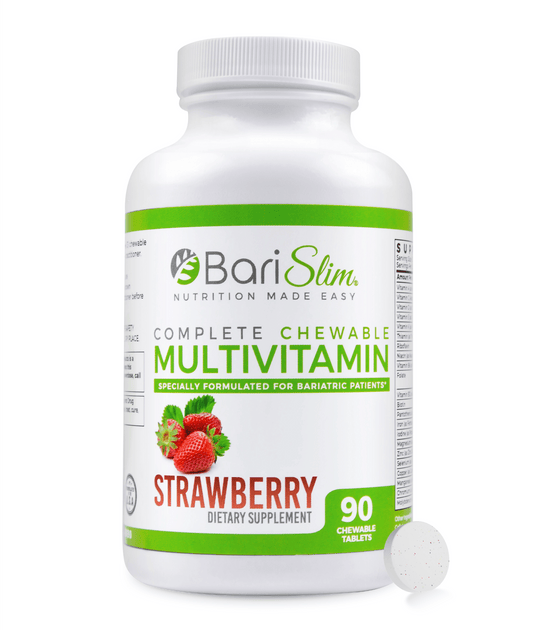
Chewables: The Early Months
Chewable tablets are what most programs start patients on, and the reasons are practical.
What They Do Well
- No swallowing required, which matters most in the first weeks.
- Broken down before they arrive, so dissolution is not dependent on reduced stomach acid.
- Available in bariatric-appropriate doses and forms.
- Flavored, which helps when taste perception is unpredictable.
Where They Fall Short
- Serving sizes are often two or three tablets rather than one.
- Chalkiness is a common complaint, particularly with calcium.
- Flavor fatigue is real over months and years.
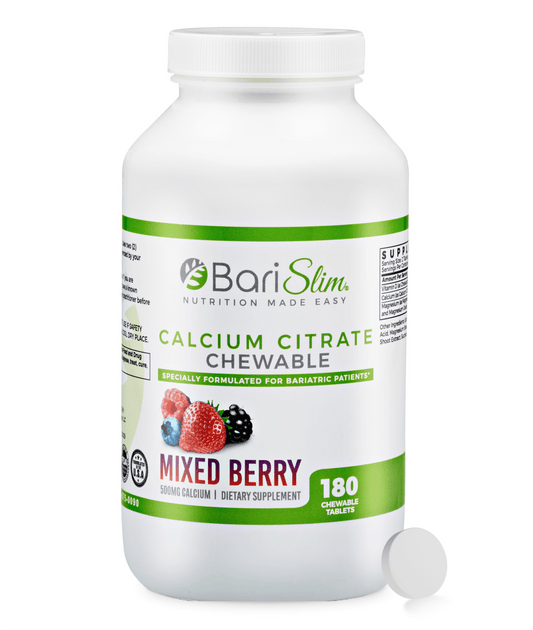
Our BariSlim Calcium Citrate Chewable provides 500mg of calcium citrate with magnesium and vitamin D per serving in a 180-count bottle, available in Mixed Berry and Tropical Punch. Calcium is a case where chewable remains the sensible format long-term for many patients, since calcium doses are divided across the day anyway.
Capsules: The Long-Term Option
Most patients can return to capsules somewhere around three to six months post-op, once swelling has settled and capacity has increased. Your program will tell you when.
What They Do Well
- One capsule, once a day, is the simplest routine to maintain for decades.
- No taste to fatigue on.
- Capsule contents disperse more readily than compressed tablets, which matters when stomach acid is reduced.
- Generally the most cost-effective format per day.
Where They Fall Short
- Not appropriate in the early post-operative period.
- Size can remain an issue for some patients permanently.
- Nothing indicates whether it dissolved properly, which is why the form of the product matters.
Our BariSlim Once Daily 45 Multivitamin Capsule packs bariatric-formulated micronutrient coverage, including 45mg of iron, into a single capsule taken once daily from a 90-count bottle, which is the simplest routine to sustain once your program has cleared you to return to capsules.
Gummies: Adherence Versus Iron
Gummies get dismissed quickly in bariatric content, usually without making the distinction that actually matters.
What They Do Well
- Adherence, which is the single biggest predictor of whether a supplement routine works. A gummy someone takes daily beats a capsule they skip.
- No swallowing, no chalkiness, and generally better tolerated when taste perception has changed.
- Useful for patients who have developed an aversion to tablets, which is common after years of them.
The Iron Question
This is the real limitation and it is worth stating clearly: iron is difficult to formulate into a gummy. It affects taste and stability, so most gummy multivitamins, including most bariatric ones, contain little or no iron.
For many patients that is a genuine problem, since iron is one of the nutrients most affected by surgery.
For others it is not, and in some cases it is preferable. Patients who need to avoid iron, and patients taking a separate iron supplement their program has prescribed, may do better with an iron-free base product regardless of format.
The Distinction That Matters
Standard grocery-store gummies are not sufficient after bariatric surgery. They are formulated for people with normal digestive anatomy, at doses built for the general population, often without the forms post-surgical absorption requires.
Bariatric-formulated gummies are a different product, built with post-surgical doses and forms. The right question is not whether gummies work, but whether the specific gummy you are considering is formulated for bariatric patients and how you are covering iron.
Our BariSlim Bariatric Multivitamin Gummies are formulated for post-surgical needs and are available individually and in a 3-pack. Discuss iron coverage with your program when choosing a gummy as your primary multivitamin.
Bariatric-Formulated Versus Standard Over-the-Counter
This distinction is more substantive than the marketing suggests, and it applies across every format.
- Calcium citrate rather than calcium carbonate, because carbonate requires stomach acid and citrate does not.
- More bioavailable mineral forms, such as chelated minerals rather than oxides.
- Methylated or more readily usable forms of certain B vitamins.
- Higher doses of the nutrients most affected by surgical changes, rather than doses set for the general population.
- Formats and serving sizes designed for a post-surgical digestive environment.
A standard drugstore multivitamin is not a cheaper version of a bariatric one. It is a different product built for a different digestive system, and after surgery the difference shows up in your labs rather than on the label.
If you are currently taking a standard over-the-counter product after surgery, that is worth reviewing with your program.
How the Right Choice Changes Over Time
Most patients do not settle on one format permanently, and they are not supposed to.
- Weeks one through eight: chewables or liquids, as your program directs. Pill size restrictions usually apply.
- Months three through six: many programs clear a return to capsules. Try one and see how it goes.
- Year one onward: whichever format you will take every day without fail, which is the only criterion that ultimately matters.
- Any point: if taste aversion, nausea, or routine fatigue is causing you to skip doses, change format rather than continue skipping. A different format you take is better than the ideal one you do not.
Calcium is often the exception to whatever else you choose. Because calcium is taken in divided doses through the day, many patients keep it as a chewable permanently even after moving their multivitamin to a capsule.
Frequently Asked Questions
Here are quick answers to the questions patients ask most often about choosing a bariatric vitamin format.
Can I just take a regular drugstore multivitamin after surgery?
It is not recommended, since standard products use nutrient forms and doses built for normal digestive anatomy, including calcium carbonate, which is poorly absorbed after surgery. Review any current regimen with your bariatric program.
When can I switch from chewables to capsules?
Most programs clear this somewhere around three to six months post-op, once swelling has settled. Ask yours rather than assuming, since timing varies by procedure and by patient.
Are gummy vitamins okay after bariatric surgery?
Standard grocery-store gummies generally are not sufficient, since they typically lack iron and provide lower doses than post-surgical needs require, while bariatric-formulated gummies are built differently, with the doses and forms post-surgical absorption requires. If you choose a gummy, discuss how you are covering iron with your program.
Why do bariatric vitamins cost more than regular ones?
More bioavailable nutrient forms cost more to produce than basic ones, and bariatric doses are higher. You are paying for forms your altered digestive system can actually absorb, which is the entire point after surgery.
What if I cannot tolerate the taste of my chewable?
Try a different flavor first, then a different format, since taste perception shifts after surgery and often shifts again over time. A supplement you avoid provides nothing, so changing is the right response rather than pushing through.
How do I know if my vitamin is actually working?
Annual labs, since symptoms are unreliable because early deficiency symptoms overlap with normal post-surgical experience. Labs are the only reliable check, and they are what should drive any change to your routine.
Support Your Routine
The best bariatric vitamin is the one you take every day for the rest of your life, in a form your body can actually absorb.
Start with what your program recommends for your stage, expect to change format at least once, and let annual labs rather than packaging tell you whether your routine is working.
That's really the same test that runs through vitamins after weight loss surgery more broadly: not which product looks right, but which one your labs confirm is actually working.
This article is for informational purposes only and should not be considered medical advice. Always consult your healthcare provider before making changes to your nutrition, exercise, supplement routine, or bariatric care plan.