Order Free Sample


Gastric sleeve is the most commonly performed bariatric procedure, and it is often described as the simpler option because the intestines are left intact.
That description is accurate as far as it goes, and it leads a lot of sleeve patients to assume their nutritional requirements are lighter than they are.
The sleeve changes stomach capacity, stomach acid production, and hunger signaling permanently, and each of those affects how you eat and what you absorb for the rest of your life, the same absorption principles our bariatric nutrition guide walks through for every procedure type.
This guide covers what the procedure changes, what recovery looks like week by week, and what a long-term nutrition routine involves.
Quick Summary
- The sleeve removes roughly 75 to 80 percent of the stomach and leaves the intestines untouched.
- Absorption is less affected than with bypass or duodenal switch, but supplementation is still a lifelong requirement.
- Reduced stomach acid affects iron, calcium, and B12, which is why form and type of supplement matter after this procedure.
- The diet progresses through clear liquids, full liquids, purees, soft foods, and regular textures over roughly eight weeks.
- Protein targets of 60 to 80 grams daily apply from the soft food stage onward for most programs.
- Long-term monitoring is annual for most sleeve patients, which is less frequent than bypass or duodenal switch but not optional.
Who This Guide Is For
This guide is designed for:
- Patients scheduled for gastric sleeve surgery.
- Sleeve patients in the early weeks working through the diet stages.
- Patients years out from a sleeve reassessing whether their routine still fits.
- Anyone comparing sleeve against gastric bypass or duodenal switch.
What the Sleeve Changes, and What It Does Not
In a sleeve gastrectomy, the surgeon removes the outer curve of the stomach and leaves a narrow vertical tube, roughly the shape and size of a banana.
Total stomach capacity drops sharply, so meals become small and fullness arrives quickly. The removed portion also produced much of the body's ghrelin, a hormone associated with hunger, which is why many patients report reduced appetite beyond what the size restriction alone would explain.
Stomach acid production is reduced along with the tissue that produced it. The small intestine itself is untouched, so food travels the normal route and the primary absorption surfaces remain in place, which is the meaningful difference between sleeve and a malabsorptive procedure like the one we cover in our gastric bypass recovery and nutrition guide, where the intestine itself is rerouted.
That distinction is real, but it is frequently over-read. Absorption is less affected, not unaffected, and eating far less food creates nutritional gaps on its own regardless of how well your intestine works.
Recovery Week by Week
Recovery follows a predictable stage progression, though your program's exact timeline may run faster or slower than this one.
Week One
Clear liquids, taken in very small amounts: water, broth, sugar-free gelatin, and diluted non-carbonated drinks. Sipping is the skill to learn here, because gulping is uncomfortable and sometimes painful. Fatigue is expected, and most patients find walking helps more than resting.
Weeks Two and Three
Full liquids and protein shakes. Meeting fluid targets is the main challenge, because stomach capacity is tiny and fluids have to be spaced away from anything else. Nausea is common and usually manageable with smaller, slower sips.
Weeks Three and Four
Pureed foods with smooth textures and no lumps, still protein-first. Portions will be far smaller than expected, often two to four tablespoons, and eating past the point of fullness at this stage is uncomfortable and worth avoiding deliberately.
Weeks Five Through Eight
Soft foods, then gradual reintroduction of regular textures. Chew thoroughly and eat slowly. Many programs keep bread, rice, pasta, and tough meats out longer than other foods because they are poorly tolerated early on.
These timelines are typical rather than universal, and they track the same stage-by-stage logic we lay out across every procedure in Diet After Bariatric Surgery, so your program's own stage schedule is still the one to follow.
Why Reduced Stomach Acid Matters More Than Patients Expect
Stomach acid does more than break down food. It converts several nutrients into forms the intestine can actually absorb.
Calcium carbonate, the form in most standard supermarket calcium supplements and antacids, requires stomach acid to be absorbed well. After a sleeve, it is a poor choice, and calcium citrate, which does not require acid, is the recommended form for bariatric patients across procedures.
Iron absorption also depends on an acidic environment, which is part of why iron deficiency occurs after sleeve even though the intestine is intact.
B12 depends on intrinsic factor, produced by stomach cells, some of which are removed during the procedure. B12 status is worth monitoring after a sleeve, not only after bypass.
This is the practical reason bariatric-formulated supplements differ from standard ones. It is not marketing. The forms and doses are chosen for an altered digestive environment.
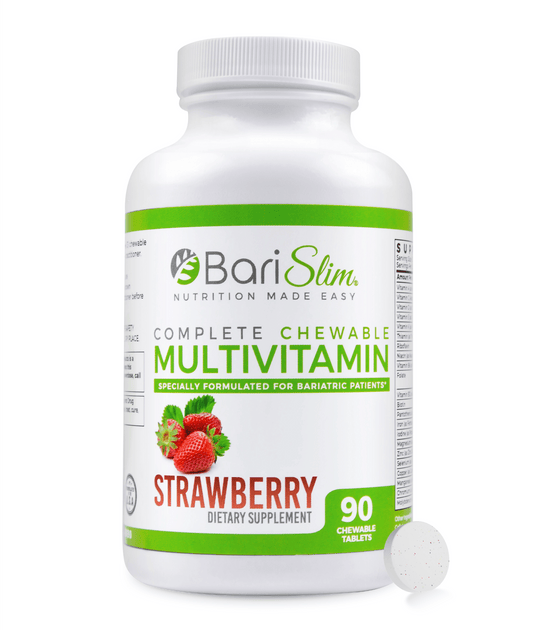
Our BariSlim Once Daily 45 Multivitamin Capsule is formulated for post-surgical absorption, with bariatric-appropriate doses and more bioavailable nutrient forms than a standard multivitamin provides. See BariSlim Once Daily 45 Multivitamin Capsule.
Protein After a Sleeve
Protein is the priority at every stage from purees onward. It supports healing, preserves muscle during rapid weight loss, and produces fullness more reliably than anything else on a small plate.
Most programs target 60 to 80 grams per day for sleeve patients during maintenance. Reaching that on a stomach the size of a banana requires deliberate structure rather than appetite.
- Eat the protein portion of every meal first, before vegetables or starch.
- Three small meals plus one or two protein-focused snacks tends to work better than three larger ones.
- Keep fluids away from meals, roughly thirty minutes either side, so liquid is not taking up the space food needs.
Tolerance varies and is unpredictable early on. Chicken breast and red meat are commonly difficult in the first months, while eggs, fish, yogurt, and cottage cheese are usually easier.
Our BariSlim High Protein Shake in Chocolate delivers 15 grams of protein in a 9-ounce, low-sugar, low-carb serving, which makes it a practical way to close the gap on days when solid food is difficult or portions still feel impossibly small. See BariSlim High Protein Shake.
Calcium, Iron, and the Rest of the Long-Term Routine
A sleeve patient's routine is simpler than a bypass or duodenal switch routine, but it is not short.
- A bariatric multivitamin daily, permanently.
- Calcium citrate in divided doses, since the body absorbs smaller amounts more efficiently than one large dose.
- Iron for patients at higher risk, particularly menstruating women, taken apart from calcium.
- B12 monitoring, with supplementation if labs indicate it.
- Vitamin D, which is commonly low before surgery as well as after.
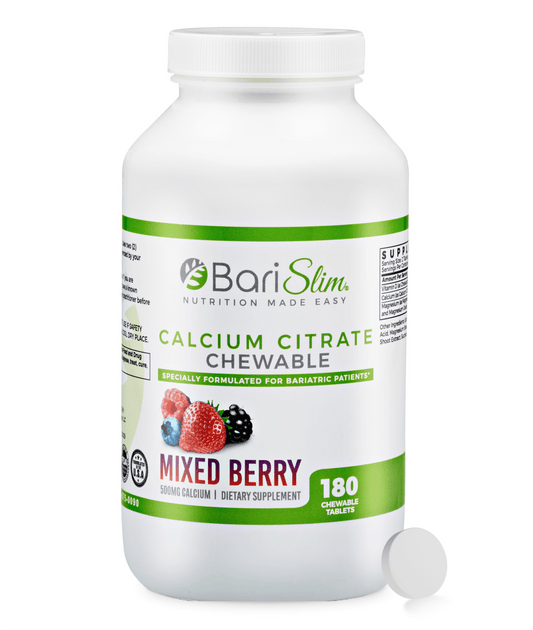
Our BariSlim Calcium Citrate Chewable provides 500mg of calcium citrate with magnesium and vitamin D per serving in a 180-count bottle, available in Mixed Berry and Tropical Punch. Calcium citrate does not require stomach acid for absorption, which is why it is the appropriate form after a sleeve. See BariSlim Calcium Citrate Chewable.
Keep calcium and iron at least two hours apart. The two minerals compete for absorption, and taking them together reduces how much of each you actually take up.
Long-Term Monitoring
Most programs schedule follow-up at intervals through the first year, then annually. Annual labs typically cover vitamin D, B12, iron and ferritin, calcium, and a complete blood count.
Sleeve patients are sometimes less rigorous about this than bypass patients, precisely because the procedure is framed as the simpler one. Deficiencies after a sleeve develop more slowly, which means they are easier to miss, not less real.
If you are more than a year out and have not had labs, that is worth raising at your next appointment.
Frequently Asked Questions
Here are quick answers to the questions sleeve patients ask most often.
Is gastric sleeve reversible?
No, the removed portion of the stomach is taken out of the body permanently. A sleeve can be revised to another procedure such as a bypass, but it cannot be undone.
Do sleeve patients need vitamins forever?
Yes. Stomach capacity and acid production are permanently reduced, so supplementation is a lifelong part of sleeve recovery, not a temporary post-op phase.
Will my stomach stretch back out?
The sleeve can accommodate somewhat more volume over time, which is normal and expected. Significant stretching is uncommon and is usually associated with consistently eating past fullness.
Why do I get full so fast but feel hungry an hour later?
Small capacity produces quick fullness that does not last long, which is why most sleeve patients move to more frequent, smaller, protein-focused meals rather than three standard ones.
Can I take regular over-the-counter vitamins after a sleeve?
Standard supplements are formulated for normal digestive anatomy, and after a sleeve, form matters, particularly calcium citrate rather than carbonate. Review any regimen with your bariatric program.
How does sleeve compare to bypass for nutritional risk?
Bypass reroutes the intestine and creates a malabsorptive component, so nutritional risk is higher and monitoring more frequent. Sleeve risk comes mainly from reduced intake and reduced stomach acid rather than bypassed absorption surface.
Support Your Routine
The sleeve is a straightforward procedure with a permanent set of nutritional requirements attached to it. The patients who do well long-term are the ones who treat the daily supplement routine and the annual labs as fixed parts of life rather than things to revisit when something feels wrong.
For the long view beyond the first year, see our guide to Life After Bariatric Surgery: The Complete Guide.
This article is for informational purposes only and should not be considered medical advice. Always consult your healthcare provider before making changes to your nutrition, exercise, supplement routine, or bariatric care plan.